
Lighting a kitchen island effectively in small homes requires balancing functional illumination with spatial economy and stylistic coherence. Our ranking highlights ten lighting solutions optimized for compact settings, providing design-savvy readers with actionable insights on fixture types, layouts, and material considerations. Each entry addresses a specific approach supported by tangible design takeaways and contextual cautions, drawn from contemporary architectural practice and interior lighting principles.
Miniature pendant lights, often no wider than 6 inches, deliver focused light directly over the kitchen island, essential for detailed food prep in small homes. Their compact scale minimizes visual clutter, keeping the ceiling plane open, which is critical where ceiling height or kitchen volume is limited. Opt for slim-profile hardware and consider spacing multiples evenly to maintain balanced illumination. Be aware that overly ornate or large fixtures can overwhelm small spaces, so restraint in design and finish is key.

Linear LED bars installed parallel to the island provide extended, uniform light coverage while consuming minimal overhead space. These fixtures are typically slim and mount close to the ceiling, which prevents encroachment into the kitchen’s limited cubic volume. They excel in offering glare-free task lighting across the entire island surface. However, the minimalist aesthetic may not suit every style, and ensuring proper color temperature compatibility with surrounding lighting is important to avoid visual discord.

Track lighting systems with adjustable heads offer adaptable illumination patterns, allowing users to focus light where needed most on the island or adjacent counters. This flexibility suits multifunctional small kitchens where activities vary with time. Mounting a low-profile track can also minimize the fixture's footprint. That said, installation requires careful planning to avoid creating a cluttered ceiling look, especially in small rooms with low ceilings.

Recessed downlights embedded in the ceiling render the lighting source nearly invisible, ideal for small kitchens aiming for an uncluttered visual environment. When positioned strategically over the island, they provide direct, shadow-minimizing light without interrupting ceiling planes. Wiring and spacing require precision to prevent uneven lighting or dark spots. A drawback is the fixed nature of recessed lights, offering limited flexibility once installed.
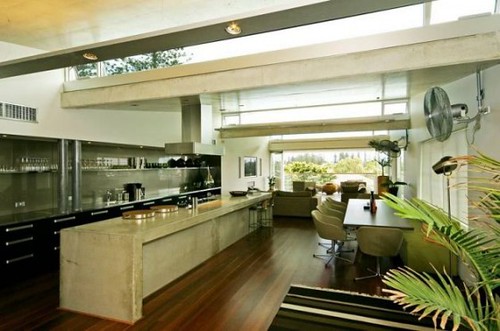
Clustered globe pendants group small spherical shades together to add vertical visual interest without overwhelming the compact kitchen space. Their often transparent or translucent materials allow light diffusion without heavy shadow casting. This setup can create a refined focal point above the island. However, the arrangement demands sufficient ceiling height clearance; otherwise, it risks reducing headroom or feeling congested in tight kitchens.

Under-cabinet LED strip lighting positioned beneath overhead cabinetry adjacent to the island supplies indirect, ambient illumination enhancing the kitchen's depth and visual warmth. It complements island lighting by reducing shadows without adding bulk. Installation is relatively straightforward and compatible with slim cabinetry designs. Keep in mind that this technique depends on adjacent cabinetry and may not directly illuminate the island surface sufficiently as a standalone source.

Flush-mount ceiling fixtures installed close to the ceiling line preserve ceiling height, a significant advantage in small kitchens where vertical space is at a premium. They provide broad, diffused light over the island area without visual intrusion. The main limitation is in design variety; flush mounts tend to be simpler, and choosing high-quality diffusers is necessary to avoid harsh shadows or glare.

Fixtures with transparent glass shades provide illumination while maintaining a sense of openness by allowing sightlines through the fixture. This quality prevents the lighting from visually crowding a small kitchen, keeping the space feeling larger. Glass can be shaped to suit various design styles, from contemporary to industrial. Caution is warranted regarding cleaning; glass shades can show dust or grease more noticeably in kitchen environments.

Using warm-toned LED bulbs (2700K to 3000K) over kitchen islands helps unify different material finishes and furniture tones, fostering a cozy yet functional atmosphere. Warm light reduces stark contrasts often seen with cooler LEDs which may appear harsh in compact homes. However, ensure bulbs chosen have a high color rendering index (CRI) to accurately reflect food colors and finishes, critical for task lighting quality.

Integrating dimmable lighting allows customization of the island’s light intensity, adapting the ambiance for cooking, dining, or casual socializing. This flexibility is especially useful in small homes where the kitchen often serves multiple purposes and mood variations. Compatibility with LED fixtures and easy-to-use controls enhance function. Consider the additional cost and electrical planning needed for dimming feature installation early in renovation phases.
Selecting the best kitchen island lighting in small homes involves balancing illumination quality, spatial constraints, and design coherence. The ranked ideas presented offer a diverse range of strategies from compact pendants to integrated LED strips, each with distinct functional and aesthetic tradeoffs. Thoughtful fixture scale, placement, and lighting control enrich the kitchen workflow while respecting limited volumes. Prioritizing flexible, high-CRI, and warm-toned lighting enhances usability and atmosphere, critical in compact settings where the kitchen island is both workspace and gathering point.
For more architecture, cities, public spaces, materials, and design ideas, browse Architecture Adrenaline’s latest guides.


