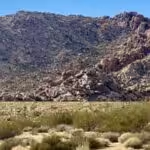
A torus in the desert embodying loose change gone colossal.

Site: Joshua Tree Piggy Bank Oasis (formerly Joshua Tree National Park, California, United States)

The Site
Joshua Tree National Park is already very good at looking like the future abandoned it on purpose. The rocks stack themselves with alarming confidence, the yuccas point in several legal directions, and the sun arrives every day like a code enforcement officer with no lunch break. Into this delicate landscape comes Desert Savings Ring, a 150-meter torus shaped like a coin ring, because the desert apparently lacked a symbol for fees.
The building sits against a pale California sky with the calm entitlement of a bank logo. Nearby hikers on the way to Skull Rock receive the full experience: silence, heat, and a reflective flash strong enough to make everyone reconsider cash.
The Move
The architectural gesture is simple. Take loose change, remove all humility, and enlarge it until it requires a security team. The torus lands as a perfect circular footprint with a flat, continuous ground edge, offering the reassuring geometry of a coin and the social warmth of a parking citation.
A 10-meter entrance arch punctures the ring at ground level. It is monumental enough to imply public access and narrow enough to suggest that access will involve a form, a wristband, and a small laminated rule sheet. This is spectacle architecture in its most honest state: a giant object asking to be admired from a distance by people who cannot afford the gift shop.
Material and Structure
The facade is made from shimmer-glass panels in a sandy palette, chosen to blend with the desert in the same way a luxury watch blends with a tax audit. At noon, the panels catch the hard sun and throw bright glimmers across the site. The effect is technically environmental, if the environment has been asking for more glare.
Structurally, the torus behaves like a coin that has discovered zoning. Its mass is colossal, its edge is blunt, and its interior void frames the sky with the financial optimism of a deposit envelope. Maintenance crews reportedly clean the reflective skin using long-handled equipment and a deep resentment of scale.
Inside
The interior begins with a cool lobby where visitors are invited to feel small, solvent, and lightly processed. From there, circulation wraps around the ring through coin vault galleries, observation lounges, climate-controlled corridors, and a leasing office staged with the solemn lighting usually reserved for villain reveals.
Several rooms are dedicated to the educational history of currency, though most guests learn the main lesson at the cafe. There is also a community room, because every future arena needs a place for residents to reserve folding tables. The lone security guard outside naps beside a small kiosk, demonstrating the building’s most humane feature.
The Tradeoff
Desert Savings Ring offers shade, spectacle, and the rare chance to stand inside a joke about capital allocation. In exchange, Joshua Tree National Park receives a permanent reflective object large enough to be seen by birds with strong opinions.
The far-future lesson is not subtle. Every Hunger Games city begins by calling the arena civic investment, then cultural programming, then an amenity. Eventually renters stop asking why the floor plan includes a viewing platform. They are simply grateful the deposit is refundable in coins.
Inside

Beneath the ring's arch, a tunnel gallery of gem-like sand reflections, windows framing the desert

At the heart of the ring, a circular stage for an absurd money-saving dance

At the zenith, an open-top observatory with a viewfinder to spot lost coins in sand dunes

Drawing set


A speculative concept by Architecture Adrenaline. Not a real building.