Visible Anchors and Tensions
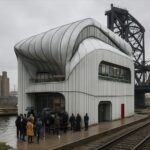
In the heart of Chicago's underbelly, the Nicholas Monchaux Intake Hall emerges not as a monolithic architectural spectacle but as a clever parasite clamped onto the city's infrastructural veins. Nestled beneath an elevated railway, the hall's facade of inflated ETFE cushions and vertical ribs mimics the relentless rhythm of train tracks above, emphasizing its symbiotic relationship with Chicago's urban skeleton. In the hero image, the intentional irony is visible: an unexpected public amenity that reads more like a control checkpoint, a spa-like refuge stitched into the harsh fabric of municipal infrastructure.
Materials and Methods
The facade's unusual mix of translucent ETFE cushions, milky fiberglass, and red emergency hardware defies expectations. It's a tactile joke, placing high-performance glazing and alien materials against the gritty texture of local limestone and the rusted remnants of industrial Chicago. Mirrored soffits bounce light that, on a snowy day, softens the building's assertive silhouette. Yet, it's this very juxtaposition that invites debate. Are these materials merely reinforcing the building's identity as an architectural punchline?
Circulation and Scale
Inside, the Entry Hall plays with scale-a large central void is framed by ribs that seem to judge those entering. Visitors queue for what appears to be a civic ritual but is more a bureaucratic encounter in disguise. The entry sequence compresses and releases, a spatial metaphor for the threshold between public sanctuary and administrative scrutiny. A security guard stands where a concierge might, framing a scene of uneasy social choreography.
Local Context and Conflict
Chicago's specific anchors-Goose Island's industrial lots, the rail geometry, and the Chicago River edge-are interwoven into the hall's DNA. The site is fraught with tensions: limited space, environmental considerations, and the quiet privatization of public waterfronts. This hall doesn't shy away from these issues; it engages in an architectural dialogue, its form dictated by site constraints yet challenging those very boundaries.
Question for Readers
Can a building that behaves like a checkpoint truly serve as a public sanctuary? Or does it merely mirror the ironies ingrained in our urban fabric?